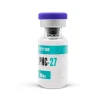

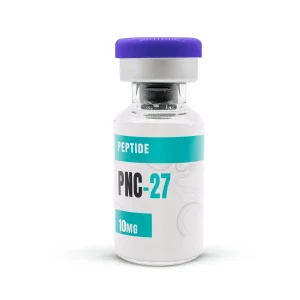
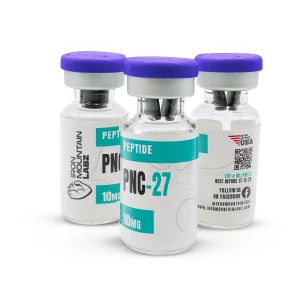
Product Details: PNC-27 (10mg)
PNC-27 is a lab-made peptide. It is a synthetic p53-derived peptide containing an HDM-2 binding domain. It is being studied in experimental and preclinical models for its interaction with membrane-associated HDM-2 proteins expressed in abnormal cell lines.
These interactions play a significant role in regulating various cellular pathways, including necrotic membrane disruption and cell membrane integrity in laboratory settings.
Originally investigated for its role in tumor suppressor-related pathways, PNC-27 has gained research interest due to its selective activity on HDM-2-expressing cell membranes.
Its defined peptide structure and receptor selectivity make it an excellent compound for studying peptide-membrane interactions and necrotic membrane disruption mechanisms in controlled experimental environments.
Mechanism of Action
In preclinical and experimental settings, PNC-27 is characterized as an HDM-2-targeting peptide. It demonstrates notable affinity for membrane-bound HDM-2 proteins overexpressed in abnormal cell models within in vitro systems. Activation of this interaction is studied for its effects on membrane destabilization and downstream necrosis.
Through targeted binding, PNC-27 is used in laboratory research to investigate HDM-2-mediated membrane disruption, apoptotic pathway activation, and peptide-driven cell regulatory mechanisms. Its selectivity for HDM-2-expressing membranes allows researchers to examine receptor-specific responses and downstream biochemical processes in controlled systems.
Importantly, published preclinical studies consistently characterize PNC-27-induced cell death as necrosis, not apoptosis. Necrosis was confirmed via LDH release assays and the absence of apoptotic markers in HDM-2-expressing cancer cell lines. This mechanistic distinction is documented in all primary published references for this compound.” [Sarafraz-Yazdi et al., 2010; Fenelus et al., 2020]
Properties of PNC-27 (10mg)
- Molecular Formula: C₁₈₈H₂₉₃N₅₃O₄₄S
- Molecular Weight: ~4,031.7 g/mol
- CAS Number: CAS Number: Not independently confirmed in major chemical registries; compound identified by sequence PPLSQETFSDLWKLLKKWKMRRNQFWVKVQRG and confirmed MW ~4,031.7 g/mol
- Peptide Sequence: PPLSQETFSDLWKLLKKWKMRRNQFWVKVQRG
- Peptide Class: Synthetic p53-derived apoptotic peptide
- Synonyms: PNC-27; PNC27; p53 peptide analog; HDM-2 binding peptide
- Purity: ≥99% (as confirmed by third-party analytical testing)
- Form: Lyophilized powder
Research Applications/Benefits of PNC-27 (10mg)
HDM-2 Membrane Interaction Research
PNC-27 is used in laboratory studies to investigate HDM-2 membrane-associated protein binding, activation, and downstream necrotic membrane disruption in controlled experimental models.
Apoptotic Pathway Studies
Applied in preclinical systems to examine peptide-induced membrane destabilization and programmed cell death pathways within abnormal cell line models and related biochemical responses.
Tumor Suppressor Signaling Analysis
Utilized in experimental models to explore p53-derived peptide involvement in tumor suppressor-related signaling and HDM-2-mediated regulatory mechanisms.
Peptide-Membrane Interaction Studies
Serves as a model compound for analyzing ligand-membrane specificity, binding affinity, and downstream intracellular necrotic membrane disruption in laboratory environments.
Selective Cell Line Targeting Investigation
Used in controlled research settings to study HDM-2 overexpression-dependent membrane disruption and its role in selective necrotic membrane disruption cascades.
Why Choose BehemothLabz to Buy PNC-27 (10mg)
BehemothLabz is committed to providing high-purity research peptides manufactured under strict quality control standards. Each batch of PNC-27 undergoes independent third-party analytical testing to confirm identity, purity, and consistency. With a focus on transparency and scientific reliability, BehemothLabz supports researchers with dependable compounds suitable for advanced laboratory and preclinical investigations.
Support is direct: support@behemothLabz.com | (307) 429-0990.
Disclaimer: This compound is not approved by the U.S. Food and Drug Administration (FDA) for human or veterinary use. It is provided strictly for laboratory and scientific research purposes only. Clinical research initiatives must be conducted under IRB guidance; preclinical animal studies must comply with IACUC directives under the Animal Welfare Act (AWA). Not for human consumption, injection, or any form of administration.
Please make sure you go through the Terms and Conditions. Please research the scientific uses of this product before making any purchases. Make note that the packaging and labels of the product may differ from those shown on the website.
Reference Links
Fenelus, M., Poon, C. K., Sarkar, A., Trivigno, V., Zolkind, P. A., Matthew, S. M., Grin’kina, N., Orynbayeva, Z., Shaikh, M. F., Adler, V., Michl, J., Sarafraz-Yazdi, E., Pincus, M. R., & Bowne, W. B. (2020). Targeting membrane HDM-2 by PNC-27 induces necrosis in leukemia cells but not in normal hematopoietic cells. PubMed. https://pubmed.ncbi.nlm.nih.gov/32878773/
Sarafraz-Yazdi, E., Mumin, S., Cheung, D., Fridman, D., Lin, B., Wong, L., Rosal, R., Rudolph, R.,
Frenkel, M., Thadi, A., Morano, W. F., Bowne, W. B., Pincus, M. R., & Michl, J. (2022). PNC-27, a chimeric p53-penetratin peptide, binds to HDM-2 in a p53 peptide-like structure, induces selective membrane-pore formation, and leads to cancer cell lysis. Biomedicines, 10(5), 945. https://www.ncbi.nlm.nih.gov/pmc/articles/PMC9138867/
Sarafraz-Yazdi, E., Bowne, W. B., Adler, V., Bhargava, A., Zeitlin, B. D., Banerjee, S., Brandwein, A., Bhatt, D., Du, M., Vu, H. H., Michl, J., & Pincus, M. R. (2010). Anticancer peptide PNC-27 adopts an HDM-2-binding conformation and kills cancer cells by binding to HDM-2 in their membranes. PubMed. https://pubmed.ncbi.nlm.nih.gov/20080680/
Bowne, W. B., Michl, J., Bluth, M. H., Zenilman, M. E., Pincus, M. R., & Sarafraz-Yazdi, E. (2008). The penetration sequence in the anticancer PNC-28 peptide causes tumor cell necrosis rather than apoptosis of human pancreatic cancer cells. PubMed. https://pubmed.ncbi.nlm.nih.gov/18931881/