

$57.98
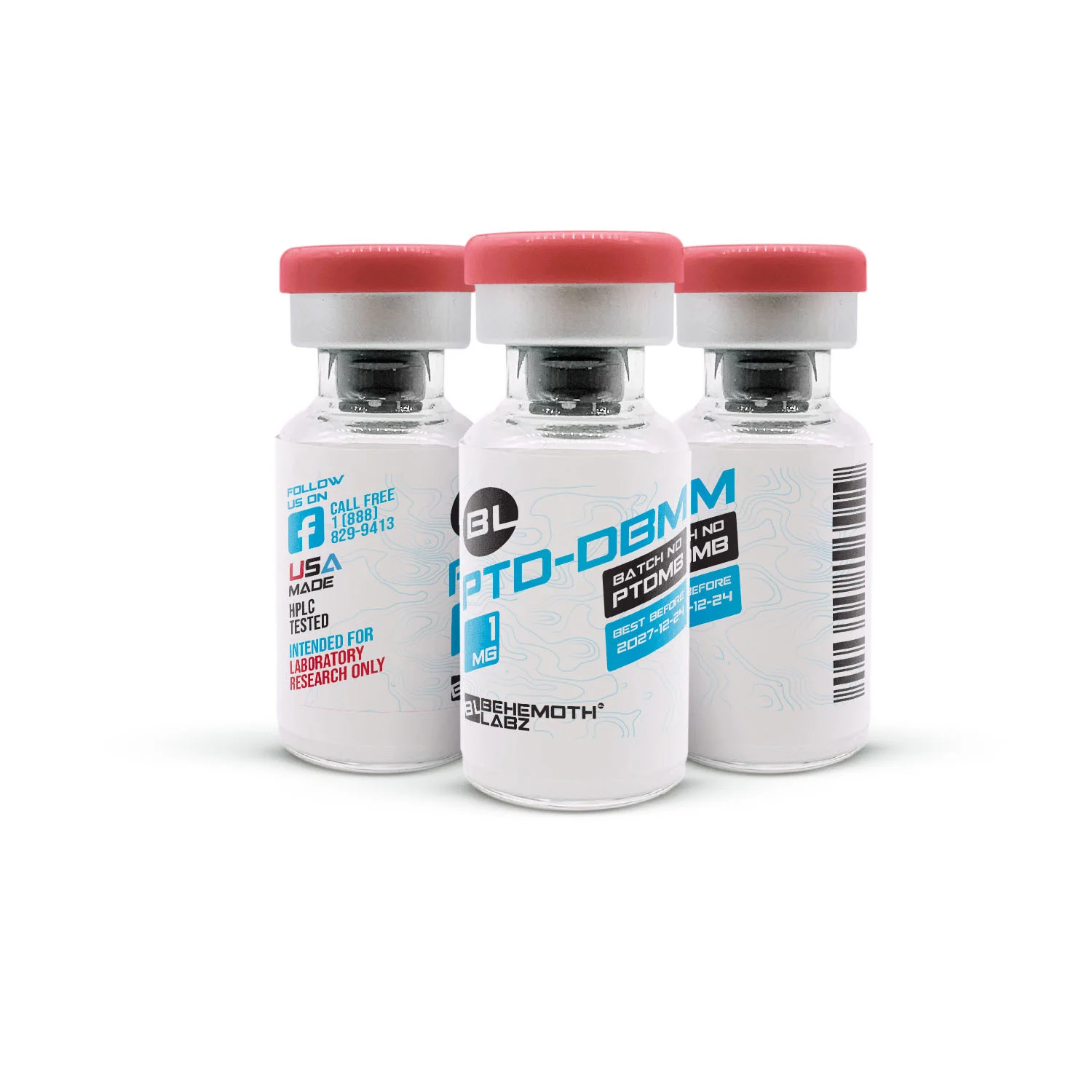
Product Details: PTD-DBM
PTD-DBM is a synthetic research compound designed for experimental investigations in cellular and molecular biology. It consists of a peptide derivative conjugated with a protein transduction domain (PTD), facilitating intracellular delivery in preclinical models. Researchers utilize PTD-DBM to study signaling pathways, cellular interactions, and regulatory mechanisms in controlled laboratory environments.
In experimental studies, PTD-DBM has been evaluated for its potential to modulate specific cellular pathways. Early preclinical research suggests that it may influence signaling networks, protein-protein interactions, and transcriptional activity in model systems.
Mechanism of Action
Upon administration in preclinical models, PTD-DBM is designed to traverse cellular membranes via its protein transduction domain. Once inside the cells, it may interact with target proteins to influence signaling cascades and modulate intracellular pathways.
This mechanism enables researchers to explore how PTD-DBM affects transcriptional regulators, protein interactions, and downstream cellular processes. In controlled studies, it has been proposed that PTD-DBM may also influence regulatory feedback loops and signal transduction dynamics in experimental models.
Properties of PTD-DBM:
- Molecular Formula: C124H225N61O28S2
- Molecular Weight: 3082.6 g/mol
- CAS Number: Not available
- PubChem CID: 176453931
- Synonym: EX-A13483
Research Applications/Benefits of PTD-DBM
Intracellular Delivery:
PTD-DBM is being investigated for its ability to penetrate cellular membranes and deliver molecular payloads into preclinical model cells. Early studies suggest that it facilitates uptake without disrupting membrane integrity, enabling controlled intracellular experiments.
Modulation of Signaling Pathways:
Researchers explore PTD-DBM for its potential to interact with key proteins involved in cellular signaling. Initial experiments indicate it may influence the activation or inhibition of specific pathways, providing a tool for pathway-focused research.
Protein Interaction Studies:
PTD-DBM may serve as a molecular probe to study protein-protein interactions in experimental models. Preclinical research has observed that it can selectively bind target proteins, allowing investigation of interaction dynamics and regulatory mechanisms.
Transcriptional Regulation Research:
Preliminary studies suggest PTD-DBM may affect transcription factor activity, offering researchers a method to examine gene expression modulation in controlled experiments.
Why Choose BehemothLabz to Buy PTD-DBM
Disclaimer: This information is for educational purposes. We do not allow the human consumption of our products. All our products are sold for laboratory and research experiments.
References:
- Ryu, Y. C., Park, J., Kim, Y., Choi, S., Kim, G., Kim, E., Hwang, Y., Kim, H., Han, G., Lee, S., & Choi, K. (2023). CXXC5 mediates DHT-Induced androgenetic alopecia via PGD2. Cells, 12(4), 555. https://doi.org/10.3390/cells12040555
- Kim, H., Choi, S., Yoon, J., Lim, H. J., Lee, H., Choi, J., Ro, E. J., Heo, J., Lee, W., No, K. T., & Choi, K. (2016). Small molecule inhibitors of the Dishevelled‐ CXXC 5 interaction are new drug candidates for bone anabolic osteoporosis therapy. EMBO Molecular Medicine, 8(4), 375–387. https://doi.org/10.15252/emmm.201505714
| Strength | 1mg |
|---|
Related products

List of Available Catalog Peptides
List of Available Catalog Peptides


List of Available Catalog Peptides

List of Available Catalog Peptides

List of Available Catalog Peptides

List of Available Catalog Peptides

List of Available Catalog Peptides


List of Available Catalog Peptides