
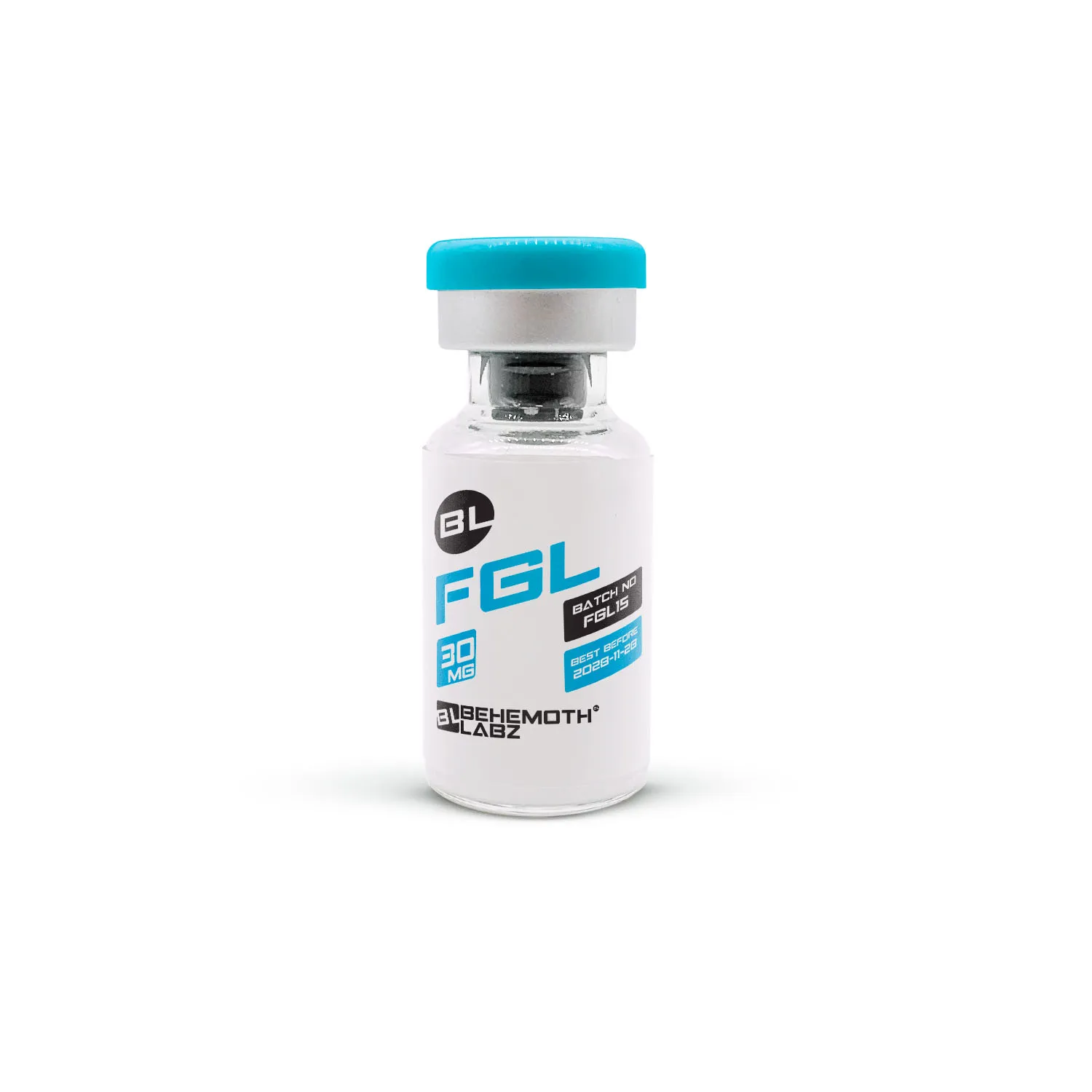
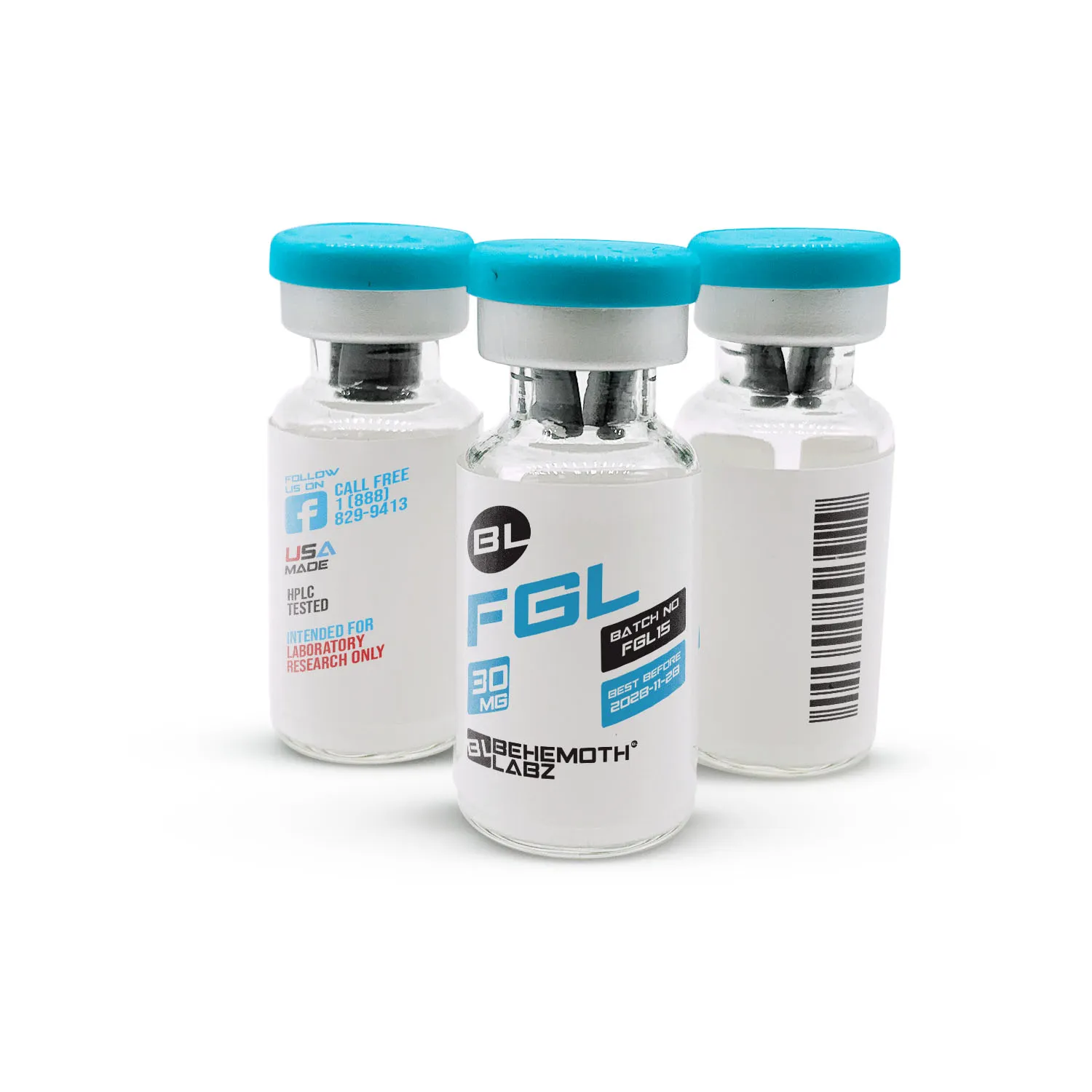
Product Details: FGL (30mg)
FGL is a lab-synthesized synthetic pentadecapeptide with the amino acid sequence Glu-Val-Tyr-Val-Val-Ala-Glu-Asn-Gln-Gln-Gly-Lys-Ser-Lys-Ala (EVYVVAENQQGKSKA in single-letter code). It corresponds to residues E681–A695 of the second fibronectin type III (F3) module of the neural cell adhesion molecule (NCAM), and is designated the FG Loop peptide, abbreviated FGL.
FGL belongs to the class of NCAM-mimetic peptide research tools — synthetic peptides designed to replicate specific functional sequences of the endogenous cell adhesion molecule NCAM, a member of the immunoglobulin superfamily that plays a pivotal role in neuronal development and synaptic plasticity.
Preclinical investigational interest in FGL centers on its proposed role in fibroblast growth factor receptor (FGFR1) activation, neurite outgrowth stimulation, and neuroprotection in research models.
This compound is supplied exclusively for controlled laboratory and scientific research purposes and is not intended for any other application.
- CAS Number: 499993-62-3
- Sequence: H-Glu-Val-Tyr-Val-Val-Ala-Glu-Asn-Gln-Gln-Gly-Lys-Ser-Lys-Ala-OH
- One-Letter Code: EVYVVAENQQGKSKA
- Chain Length: 15 amino acids (pentadecapeptide)
- Molecular Origin: Second F3 module of NCAM (residues E681–A695)
- Molar Mass: 1,649.8 g/mol (free acid form, confirmed | PubChem CID 16200289)
- Classification: NCAM-Mimetic Peptide / FGFR1 Agonist
- Synonyms: FG Loop peptide; FGL peptide; NCAM-FGL; FGLm
- Ingredients / Composition: FGL (EVYVVAENQQGKSKA) as the key component at 98%+ purity
- Shelf Life: 2 years (lyophilized, sealed)
- Storage Instructions: Store as lyophilized powder at –20 °C or below, protected from light and moisture
- Regulatory Status: Research Use Only (RUO). Not approved by the FDA for use outside controlled laboratory settings.
Mechanism of Action
In preclinical and experimental research settings, FGL is characterized as an NCAM-mimetic FGFR1 agonist and neuromodulatory research tool.
Investigational data from Kiselyov et al. and Berezin et al. established that the FGL sequence, derived from the second F3 module of NCAM, directly interacts with the Ig3 module of FGFR1, activating downstream intracellular signaling cascades associated with neuronal survival, neurite extension, and synaptic connectivity. This interaction mimics the physiological NCAM–FGFR binding event at the cell surface.
Preclinical studies associate FGL-mediated FGFR1 activation with engagement of downstream MAP kinase, Akt, and CaMKII phosphorylation cascades in hippocampal and cortical cell systems. Research in NCAM-deficient preclinical models demonstrated that FGL restored reduced basal FGFR1 and CaMKII phosphorylation levels, consistent with its proposed role as a functional NCAM surrogate at the receptor level [Bhatt et al., 2010].
Research Applications of FGL (30mg)
FGFR1 Activation and Intracellular Signaling Research
FGL is utilized in laboratory settings to investigate direct peptide–receptor binding dynamics at the FGFR1 Ig3 module, activation of MAP kinase and Akt phosphorylation cascades in neuronal cell systems, and downstream effects on CaMKII and CaMKIV signaling in hippocampal and cortical preclinical research models under controlled in vitro conditions.
Synaptic Plasticity and Cognitive Function Research
Preclinical findings associate FGL with enhancement of synaptic connectivity and memory consolidation in rodent research models. FGL may serve as an investigational research tool for analyzing long-term potentiation (LTP) dynamics, spatial learning pathway modulation, and social memory retention mechanisms in controlled behavioral and electrophysiological preclinical research settings.
Neuroimmunology and Microglial Modulation Research
Research data associate FGL with attenuation of LPS-induced microglial activation and reduction of age-related inflammatory cytokine changes through CD200-dependent pathways. FGL may be applied in controlled preclinical models to investigate neuroinflammatory pathway regulation, glial quiescence mechanisms, and cytokine balance dynamics in aging and neurodegeneration-relevant research systems.
Blood-Brain Barrier Penetration and Pharmacokinetic Studies
Preclinical pharmacokinetic data indicate that FGL penetrates into the blood and cerebrospinal fluid compartments within a measurable time window following administration in rodent research models. Used in controlled laboratory environments to study CNS bioavailability dynamics, nose-to-brain delivery system compatibility, and peptide stability profiling in pharmacokinetic research settings.
Why Choose BehemothLabz to Buy FGL (30mg)?
BehemothLabz is committed to providing high-purity research peptides manufactured under strict quality control standards. Each batch of FGL undergoes independent third-party analytical testing to confirm identity, purity, and consistency.
With a focus on transparency and scientific reliability, BehemothLabz supports researchers with dependable compounds suitable for advanced laboratory and preclinical investigations. Competitive pricing, secure payment processing, and domestic and international shipping availability further support researchers at every level.
Support is direct: support@behemothlabz.com | (307) 429-0990
Disclaimer
This compound is not approved by the U.S. Food and Drug Administration (FDA) for any purpose. It is provided strictly for laboratory and scientific research purposes only. Clinical research initiatives must be conducted under IRB guidance; preclinical studies must comply with IACUC directives under the Animal Welfare Act (AWA). Not for any form of administration outside of controlled laboratory research settings.
Please make sure you review the Terms and Conditions and familiarize yourself with them prior to purchasing. Please research the scientific uses of this product before placing any orders. Please note that the packaging and labels of the product may differ from those shown on the website.
FAQs
Is FGL legal in the United States?
FGL is a research peptide not approved by the FDA for use outside of controlled laboratory settings. It is not approved for human or veterinary administration under any circumstances.
What is FGL, and what is it investigated for in preclinical research?
FGL is a synthetic 15-amino acid NCAM-mimetic peptide (EVYVVAENQQGKSKA) derived from the second F3 module of NCAM. In preclinical settings, it is investigated as a FGFR1 agonist with proposed roles in neurite outgrowth stimulation, neuroprotection, synaptic plasticity modulation, and microglial quiescence regulation in controlled neuronal and glial research models.
What signaling mechanisms is FGL associated with in preclinical data?
Preclinical data associate FGL with FGFR1 Ig3 module binding and receptor phosphorylation, downstream activation of MAP kinase, Akt, and CaMKII pathways in hippocampal models, upregulation of CD200 glycoprotein expression in microglial research systems, and attenuation of LPS-induced pro-inflammatory cytokine production in controlled in vitro neuroimmunology settings.
What are the storage and handling requirements for FGL?
FGL is supplied as a lyophilized powder. Store at –20 °C or below, protected from light and moisture. Reconstitute using bacteriostatic water under sterile aseptic laboratory conditions. Once reconstituted, aliquot immediately to minimize freeze-thaw degradation and store at 4 °C for short-term use; do not refreeze reconstituted solution. Researchers are advised to consult the applicable Safety Data Sheet (SDS) prior to handling.
Reference Links
Secher, T., Berezin, V., Bock, E., & Glenthøj, B. (2009). Effect of an NCAM mimetic peptide FGL on impairment in spatial learning and memory after neonatal phencyclidine treatment in rats. Behavioural Brain Research, 199(2), 288–297. https://pubmed.ncbi.nlm.nih.gov/19133297/
Bhatt, D. L., et al. (2010). NCAM-mimetic, FGL peptide, restores disrupted fibroblast growth factor receptor (FGFR) phosphorylation and FGFR mediated signaling in neural cell adhesion molecule (NCAM)-deficient mice. European Journal of Neuroscience, 32(2), 301–309. https://pubmed.ncbi.nlm.nih.gov/19909731/
Minogue, A. M., et al. (2014). The neural cell adhesion molecule-derived peptide, FGL, attenuates lipopolysaccharide-induced changes in glia in a CD200-dependent manner. Neuroscience, 261, 79–88. https://pubmed.ncbi.nlm.nih.gov/23337536/
Pedersen, M. V., et al. (2008). The synthetic NCAM-derived peptide, FGL, modulates the transcriptional response to traumatic brain injury. Neuroscience Letters, 437(2), 148–153. https://pubmed.ncbi.nlm.nih.gov/18455880/
Neiiendam, J. L., et al. (2004). An NCAM-derived FGF-receptor agonist, the FGL-peptide, induces neurite outgrowth and neuronal survival in primary rat neurons. Journal of Neurochemistry, 91(4), 920–935. https://pubmed.ncbi.nlm.nih.gov/15525347/